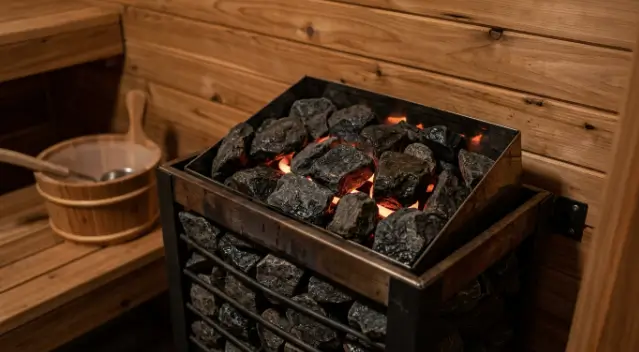
An electric sauna heater purchase comes down to eight checks: kilowatt output matched to the room’s cubic footage, the voltage and circuit the unit requires, rock capacity, the type of control panel, guard rail clearance specs, safety certification, warranty length, and physical footprint. Get the kilowatt sizing and electrical requirements right and most of the rest is a matter of preference and budget. Get them wrong and the heater either never reaches target temperature or trips breakers, both of which are expensive problems to discover after installation rather than before ordering.
1. Kilowatt Output Matched to Room Volume
Heater output is sold in kilowatts, and the number that matters is cubic footage, not square footage. A common starting reference is roughly one kilowatt per 45 to 60 cubic feet for a tight, well-insulated cabin, though every manufacturer publishes its own sizing chart that accounts for ceiling height, glass area, and insulation quality. A two-person cabin around 150 cubic feet typically lands in the 4.5 to 6 kilowatt range, while a larger six-person cabin closer to 400 cubic feet often needs 8 to 9 kilowatts. Undersizing is the single most common heater mistake, since an undersized unit runs constantly and still falls short of target temperature, which shortens its working life while delivering a worse experience.
2. Voltage and Circuit Requirements
Most residential heaters above roughly 6 kilowatts require a dedicated 240-volt circuit with its own breaker, and confirming panel capacity for that circuit before ordering avoids a costly surprise later. Smaller heaters under about 2 kilowatts sometimes run on a standard 120-volt household outlet, which is far simpler to install but limits how much cabin volume they can realistically heat, generally suiting only very small one-person cabins. Larger heaters, roughly 10 kilowatts and up, often need a contactor box as an intermediate switching component between the breaker and the heater itself, which adds a small amount to installation cost and complexity that is worth budgeting for ahead of time rather than discovering mid-install.
3. Rock Capacity and Rock Type
Rock capacity generally scales with kilowatt rating, commonly running 40 to 60 pounds on a mid-size residential unit and more on larger commercial-style heaters. More rock mass holds heat more evenly and stabilizes humidity better when water is ladled on for steam, compared with a heater that has a shallow rock bed and cools quickly between pours. Look for a heater that specifies both a minimum and maximum rock weight, since overloading the heating element with too much rock mass restricts airflow and can shorten element life just as much as running it with too little.
4. Control Panel: Mechanical, Digital, or App-Based
Basic heaters use a mechanical dial for temperature and a simple timer knob, which is reliable and inexpensive but offers no preheat scheduling. Digital control panels add a programmable timer, letting the cabin reach target temperature on a schedule without anyone needing to start the heater and wait nearby. App-connected models extend that further with remote start from a phone, useful for someone who wants the cabin ready the moment they get home. The digital and app upgrades add $150 to $400 or more over a basic mechanical unit, and for most households the preheat timer alone justifies the cost, since it avoids either running the heater unattended for a long stretch or standing around waiting for it to heat up.
5. Guard Rail and Clearance Specs
Every heater manufacturer specifies a minimum clearance from the guard rail to the nearest bench or wall surface, commonly in the 3 to 4 inch range, and a matching guard rail is required equipment, not an optional accessory. This clearance exists to prevent accidental contact with the heating element and to maintain the airflow the heater needs to perform correctly. Confirm the heater’s published clearance specs against the actual cabin dimensions before ordering, since a heater that technically fits the kilowatt sizing chart can still be a poor match if the cabin’s bench layout does not leave enough room for the required guard clearance.
6. Certification and Safety Listing
Look for UL or ETL listing on any heater before buying, which confirms the unit passed independent electrical safety testing rather than relying solely on the manufacturer’s own claims. This matters most for the heating element and internal wiring, the parts of the unit running at full household voltage in a hot, humid enclosure for years at a stretch. A heater without a visible safety listing on the spec sheet or nameplate is worth treating as a red flag, particularly on lower-priced imported units where the listing is sometimes omitted rather than simply hard to find. Buyers comparing heaters across brands, including the electric options carried by SweatDecks, should check for this certification as a baseline requirement before comparing price or features.
7. Warranty Length and What It Covers
Warranty terms vary more than most buyers expect. Look for at least two years on the heating element itself, with five or more years common among established brands, and check whether the control panel and wiring harness carry the same term or a shorter one, since some manufacturers split coverage between components. A warranty under two years, or one not stated clearly on the product page, is a common signal of a lower-quality import heater, and it is worth reading the actual warranty terms rather than assuming a longer number on a marketing page covers every part of the unit equally.
8. Physical Footprint and Mounting Style
Heaters mount either freestanding on the floor, wall-mounted above the floor, or recessed into a corner niche, and the choice affects both bench layout and how much usable floor space is left in a small cabin. Corner and wall-mounted units free up floor space in a two-person cabin where every square foot matters, while freestanding floor units are generally easier to service since there is access on more sides. Measure the heater’s physical footprint and mounting height against the cabin’s actual bench plan before ordering, not just against the general kilowatt sizing chart, since two heaters with identical output can have noticeably different physical dimensions depending on how the manufacturer arranges the heating elements and rock bed.
Frequently Asked Questions
What kilowatt heater does a small home sauna need? A well-insulated two-person cabin around 150 cubic feet typically needs 4.5 to 6 kilowatts, based on cubic footage rather than floor space.
Does an electric sauna heater need a 240-volt circuit? Most heaters above roughly 6 kilowatts need a dedicated 240-volt circuit. Smaller units under 2 kilowatts can sometimes run on a standard 120-volt outlet.
How much rock capacity should a sauna heater have? Commonly 40 to 60 pounds for a mid-size residential heater, scaling up with kilowatt rating.
Is a digital control panel worth the extra cost? For most households, yes, mainly for the preheat timer that lets the cabin reach temperature on a schedule without running the unit unattended.
References
- Cardiovascular and Other Health Benefits of Sauna Bathing: A Review of the Evidence, Mayo Clinic Proceedings, 2018
- Effects of heat and cold on health, with special reference to Finnish sauna bathing, American Journal of Physiology, 2018
- Benefits and risks of sauna bathing, The American Journal of Medicine, 2001
By Marcus Delaney